Short stories

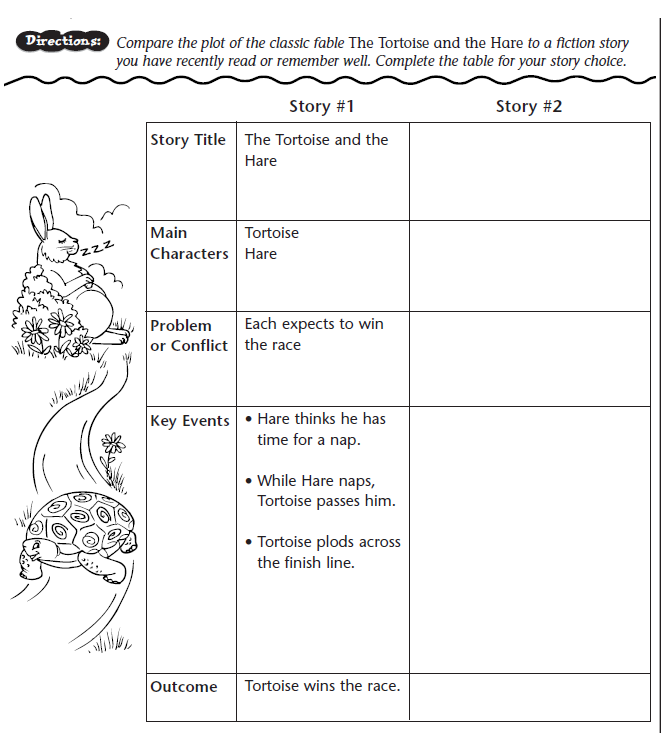
A wolf who had a bone stuck in his throat hired a crane, for a large sum, to put her head into his mouth and draw out the bone. When the crane had extracted the bone and demanded the promised payment, the wolf, grinning and grinding his teeth, exclaimed, “Why, you have surely already had a sufficient recompense, in having been permitted to draw out your head in safety from the mouth and jaws of a wolf.”
The soloists in the big bands improvised from the melody. The young musicians who ushered in bebop, notably trumpeter Dizzy Gillespie and saxophonist Charlie Parker, expanded on the improvisational elements of the big bands. They played with advanced harmonies, changed chord structures, and made chord substitutions. These young musicians got their starts with the leading big bands of the day, but during World War II—as older musicians were drafted and dance halls made cutbacks—they started to play together in smaller groups.
From the beginning to the end of this book, I have most earnestly represented the necessity of forming early habits of observation. It is a strong foundation, on which any kind of character may be built, as circumstances require. It makes good writers, good painters, good botanists, good mechanics, good cooks, good housewives, good farmers—good everything! It fits us for any situation in which Providence may place us, and enables us to make the most of whatever advantages that come in our way. It is a sort of vital principle, that gives life to everything.
When I think of my family’s history on the land, I experience a pang of regret. Unlike much of the arid West, where the land has gone virtually unchanged for centuries, my place of origin, western Kansas, has been torn up by agriculture. The flat plains, excellent soil, and sparse but just adequate rainfall permitted farming; therefore farming prevailed, and a good 90% of the original sod prairie is gone. The consequence, in human terms, is that our relationship to our place has always felt primarily mercantile. We used the land and denied, or held at bay, its effect on us. Yet from my earliest childhood, when most of the Kansas prairie was still intact, I’ve known that the land also had a romantic quality. I’ve felt moved by the expanse of it, enthralled by its size. I take pride in my identity as a plains daughter.
Juan Canito and Señor Felipe were not the only members of the Señora’s family who were impatient for the sheep-shearing. There was also Ramona. Ramona was, to the world at large, a far more important person than the Señora herself. The Señora was of the past; Ramona was of the present. For one eye that could see the significant, at times solemn, beauty of the Señora’s pale and shadowed countenance, there were a hundred that flashed with eager pleasure at the barest glimpse of Ramona’s face; the shepherds, the herdsmen, the maids, the babies, the dogs, the poultry, all loved the sight of Ramona; all loved her, except the Señora. The Señora loved her not; never had loved her, never could love her; and yet she had stood in the place of mother to the girl ever since her childhood, and never once during the whole sixteen years of her life had shown her any unkindness in act. She had promised to be a mother to her; and with all the inalienable staunchness of her nature she fulfilled the letter of her promise.
The main character of this passage, William, copies and translates business-letters for a living. But, he is not satisfied with his occupation. He finds it annoying, dry and tedious. He had taken a resolution to become a tradesman, but he is regretting his choices now, and he wishes to have done things differently. On top of that, there is antipathy which has sprung up between himself and his employer, Edward Crimsworth. William thinks that his accent, education, punctuality, industry and accuracy irritated Edward and that Edward envied him because he thought that William should one day make a successful tradesman, too. William also knew that Edward believed that William had a mental wealth that he didn’t want to share. If Edward could have placed him in a ridiculous or mortifying position, he would, but William was cautious, tactical and he observed carefully, so Edward couldn’t do anything to him. After William had received his first quarter’s wages, he was returning to his lodgings and was thinking about how his life was intolerable and how he could change it.
When Jessye Norman's parents were knocking on the wall of their young daughter's roomas a signal for her to stop singing and to go to sleep, little did they dream that this small child who seemed to have been born singing would grow up to be an internationally renowned opera singer.
It is not surprising that Jessye loved to sing. Music was an integral part of her family's lifestyle. Although Jessye remembers her mother singing spirituals, it was her grandmother who was always singing. Every hour of her day and every mood was highlighted with a song that fit the occasion. As Jessye was growing up, her piano-playing mother and trumpet- and trombone-playing brothers accompanied her when the family was called upon to provide special music for church services, parent-teacher meetings, and ribbon-cutting ceremonies. During her childhood, Jessye knew only three operatic songs: one that she learned from a recording and two others - the only opera scores she could find at the local music store. Although singing was in her blood, it was not until she attended Howard University that Jessye Norman took her first voice lesson with Carolyn Grant, who recognized her talent and knew how to channel it. It was almost immediately after leaving the university in 1968, on her first visit to Europe, that Jessye won the singing prize in the International Music Competition of German Radio. The following year, she was invited to go to Berlin to perform at the Deutsche Opera. Since that time, Jessye Norman has become a world superstar whose singular voice reaches audiences all over the world.